








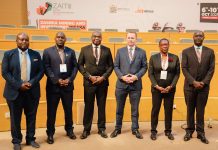


For more than a decade, Ian Mwiinga has been the face of ZEITI – the organisation that has given Zambians an independently verified picture of what is extracted, what is earned, and what reaches the public purse. Now, having accepted an appointment to the international board of the Extractive Industries Transparency Initiative (EITI), he takes his place among the select few professionals worldwide who shape global standards for mineral transparency.
How does a boy from Monze make it to the top?
Mr Mwiinga’s rise was far less about circumstance than character. He is, above all, a lifelong learner – someone who’s consistently sought out the next degree, the next challenge, and the next conversation with someone who knows more than he does. “I was driven from early on in life,” he says.
In the first of this two-part interview, we speak to Mr Mwiinga about his early years, what shaped him, and how a shy boy ended up at the forefront of Zambia’s minerals transparency agenda.
***
Where did you grow up, and what were you like at school?
I was born and bred in Zambia. I’m Tonga by tribe and I grew up in Monze in Southern Province.
I started off as a shy person. What really helped me break out of my shell was being part of the debate club at secondary school, which thrust me into the public speaking space. This skill is now the cornerstone of my work: I make presentations in public; I have to ensure my thoughts are coordinated.
Going to boarding school at Pemba Secondary School – where I completed my Grade 12 – was formative. It was a boys’ school, and being away from home gave me an early taste of independence. The friendships I made with my peers as an altar boy in the Catholic church were also formative, and I’ve kept many of those same friendships.
What did you do after school?
After high school, I did a diploma in journalism at Evelyn Hone College here in Lusaka. After that, I did Development Studies in Ireland and Economics in Manchester. But in my heart of hearts, I always wanted to do law.
I’m now back at school, completing my law degree in December this year. I never wanted to look at law in isolation – I wanted to add an economic angle, and that’s how my interest in economics grew. Incidentally, both elements converge in the mining sector, where one is trying to balance how natural resources are managed.
How on earth do you find the time between your career and family to do a law degree? You must not sleep at night!
Well, my wife is certainly not amused! The University of Lusaka has a very good part-time programme which starts after 5pm, so you can attend class for two hours and get back home by the evening.

You have a postgraduate Economics degree from the University of Manchester, a Master’s in Economics from UNZA, a degree in Development Studies, and a journalism diploma. It’s an unusual but potent combination. Tell us how you came to follow this particular path.
My foundation was journalism and it gave me a broad base. You develop a nose for news, but also a nose for understanding information and data. The training grounded me in several spheres: economics, the legal side of the media, philosophy, and so on. But it became clear that I needed more. I got an opportunity to study in Ireland: a degree in Development Studies at Kimmage Development Studies Centre in Dublin.
What was profound for me was the difference in the education system. Coming from here, where the focus was mainly on exam-based learning, I had to grow into academic writing and learn to defend my ideas. One of the things that really opened my mind was the concept of critical thinking; you start asking questions about everything!
Another big change was the multicultural nature of the institution. There were students from across the world – Asia, the Middle East, other parts of Africa, Latin America, Europe – which continuously shaped the way I related to people and grew in my thinking.
Ireland is cold and it rains the whole year, so while I was far from home and learning fast, I also had to adjust on a personal level. The good thing is there were a couple of other Zambians there – Barnabas, Cornelius, and the late Mildred – and the four of us became a Zambian community.
My writing also started developing in Dublin. I learned to move from the journalism style of ‘he said, she said’ news reporting, to immersing myself in the details, arguing a case, and developing a clearer sense of my own voice and what I stood for.
“What was profound for me was the difference in the education system. One of the things that really opened my mind was the concept of critical thinking; you start asking questions about everything!”
Why did you decide to pursue economics?
After getting my Development Studies degree, I was deciding whether to immediately pursue law or do an intermediate course. It was 2008 – the global financial crisis – and all the news was about economics, the price of oil, stocks, etcetera. I thought, “This is one of those interesting areas I should explore.”
I already had exposure to basic economics and wanted to really understand the science of it. Little did I know how quantitative economics is… I recall thinking to myself that I came to study economics and not mathematics! I later realised that for one to be a good economist, you need to have a good grasp of mathematics because of the precision required in economic analysis.
After finishing a postgrad diploma at University of Manchester, I thought ‘Why not stretch it further?’ That’s how I came to do my Master’s in Economics at the University of Zambia.
I was studying on a part-time basis, and it was at this point that I started working for the Zambia EITI Secretariat in the mining sector – a totally new area. The mining sector is a multi-disciplinary environment that requires engagement with a variety of technically challenging issues. My work with the EITI fortified my resolve to pursue knowledge that would deepen my analytical rigour.
As they say, the rest is history.
***
In Part 2 of this exclusive interview with Mr Mwiinga, we find out how he came to join the ZEITI, what his secondment to the EITI’s international secretariat in Oslo set in motion, and what Zambia’s recent validation score means for the country’s minerals transparency agenda – and the work that lies ahead.
See also: Financial Flows: Where does the money from mining go?